
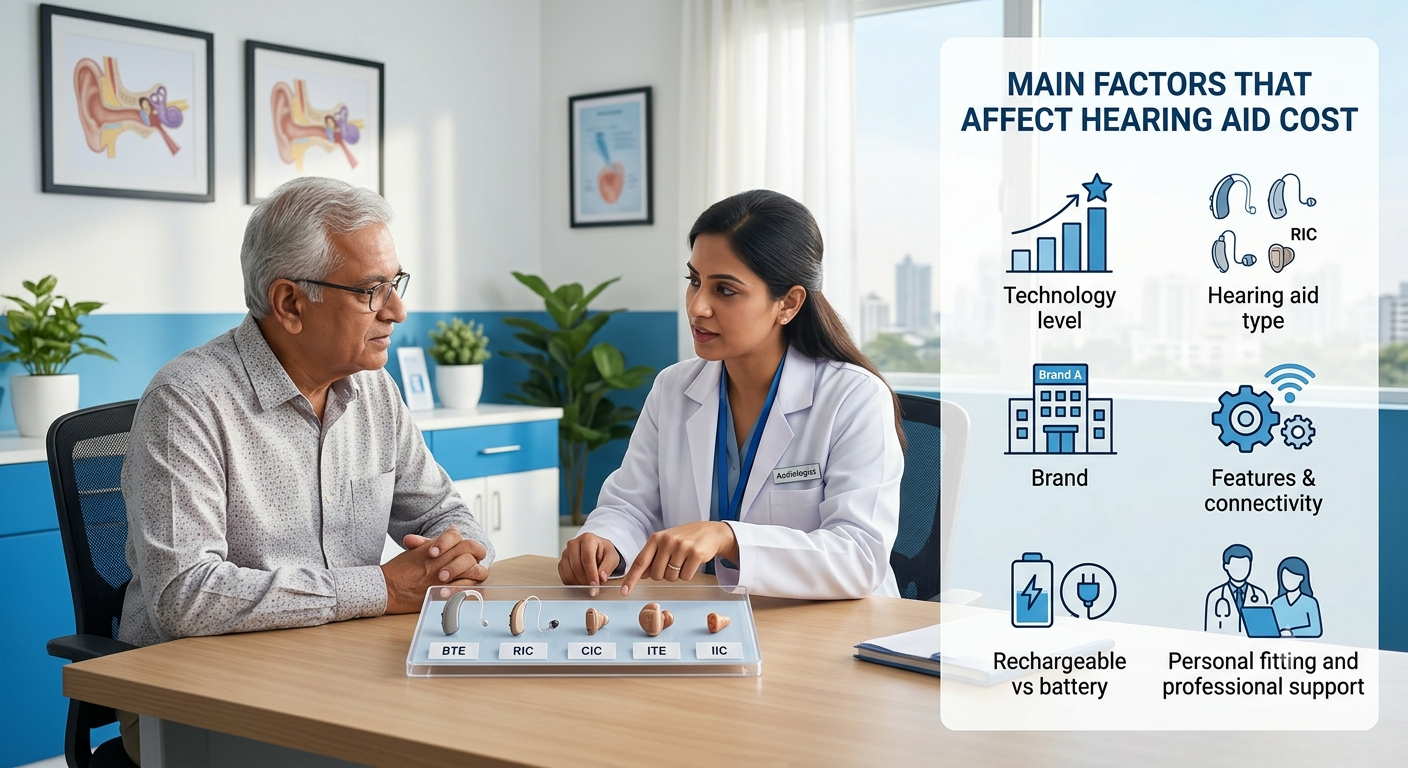
One of the first questions almost everyone asks when they start researching hearing aids is simple: "How much will this cost me?" Unfortunately, the honest answer is "it "depends"—hearing aid pricing varies dramatically based on technology, brand, style, and the level of service that comes bundled with the device. This guide breaks down exactly what drives hearing aid costs so you can budget realistically and avoid overpaying—or underpaying—for a device that won't meet your needs.
The General Price Range
In India, digital hearing aid prices typically range from around ₹21,000 for basic, entry-level devices to upwards of ₹8,50,000 for premium, top-of-the-line models with advanced AI processing and full smart features. That's an enormous spread, and understanding what separates a ₹25,000 device from a ₹5,00,000 device is key to making a smart purchase decision.
Factor 1: Technology Tier
Hearing aids are generally grouped into tiers — often labeled basic, standard, advanced, and premium (naming varies by manufacturer). The tier determines:
- How well the device manages background noise. Premium tiers use more sophisticated algorithms to separate speech from noise, which matters enormously in restaurants, markets, or family gatherings.
- How quickly and smoothly the device adapts to changing environments — walking from a quiet room into a noisy street, for example.
- The number of listening programs and automatic adjustments available without manual input.
- Feedback (whistling) management quality, which affects overall comfort and sound clarity.
Someone who mostly spends time at home in quiet environments may do perfectly well with a basic or standard tier device, while someone who's frequently in restaurants, meetings, or social settings will likely benefit more from an advanced or premium tier.
Factor 2: Style and Form Factor
As covered in hearing aid style guides, custom in-canal devices (like CIC or IIC) are generally more expensive to manufacture than standard BTE or RIC shells, due to the custom molding process. However, the style itself is usually a smaller factor in overall price compared to the technology tier inside the device.
Factor 3: Connectivity and Smart Features
Bluetooth streaming, smartphone app control, rechargeable batteries, and AI-powered environment detection all add to cost. If you specifically want to stream phone calls or music directly to your hearing aids, or want app-based fine-tuning without visiting the clinic, expect this to push you toward mid-to-premium price tiers.
Factor 4: Brand
Leading global brands — Phonak, Signia, Widex, ReSound, Beltone, and Starkey — each price their devices somewhat differently based on their proprietary technology and manufacturing costs. No single brand is universally "the most affordable" or "the most expensive" across every tier; pricing needs to be compared model-by-model and tier-by-tier for a fair comparison.
Factor 5: Bundled Services
This is the factor most people overlook. The listed price of a hearing aid often does not reflect the full picture of what you're paying for. Ask specifically whether the price includes:
- Initial hearing evaluation and fitting
- Follow-up programming adjustments (and how many, over what time period)
- Ear mold or custom shell fabrication, if applicable
- Warranty duration and what it covers
- Free or discounted servicing and cleaning
- Loaner devices during repairs
A slightly higher upfront price that includes lifetime free servicing and multiple fitting adjustments can end up being significantly better value than a cheaper device sold with minimal after-sales support.
Are Cheaper Hearing Aids Worth Considering?
Entry-level hearing aids can be a reasonable choice for people with mild hearing loss, simple lifestyle needs, and a tight budget—they are far better than no amplification at all. However, buyers should be cautious of unusually cheap, unbranded, or "one-size-fits-all" amplifiers sold without a proper hearing evaluation or fitting. These often provide poor sound quality, inadequate noise management, and no professional support if something goes wrong.
How to Get Fair, Transparent Pricing
The best way to avoid overpaying — or being upsold on features you don't need — is to get a proper hearing evaluation first, followed by a transparent discussion of tiers, trade-offs, and total costs including bundled services. A clinic that provides free hearing check-ups and trial periods lets you evaluate real-world performance before committing financially, rather than relying on a sales pitch alone.
For residents exploring affordable hearing aid options in Thane, it's worth choosing a clinic that offers a wide range of genuine hearing aids from leading brands at competitive prices, along with free hearing check-ups, hearing aid trials, and ongoing after-sales support — rather than a single narrow product line pushed regardless of individual hearing needs.
Financing and EMI Options
Because premium hearing aids can represent a significant expense, many clinics now offer EMI or financing arrangements to spread the cost over several months. If budget is a barrier, it's worth asking directly about available payment plans rather than settling for a device that doesn't properly address your hearing loss.
Final Thoughts
Hearing aid pricing reflects a genuine range of technology, features, and bundled services—not an arbitrary markup. The smartest approach is to get a professional hearing evaluation, understand your actual hearing needs and lifestyle, and then compare devices tier-by-tier with full transparency on what's included in the price. A well-matched mid-range device with strong after-sales support will usually serve you far better than the cheapest or most expensive option chosen without proper guidance.